
Recruiting Gen Z is getting harder, and most employer brand teams feel it before they can name it.
Career fairs cost more and deliver less every year. You book the booth, print the banners, send the team, and you reach a shrinking slice of the people you actually want. Measuring the return is almost impossible, and deep down everyone knows the numbers don’t quite add up.
Underneath that sits a harder problem, the one nobody wants to say in a leadership meeting: for a lot of established brands, the employer image is aging. The company your parents respected is not the company a 19-year-old dreams of joining. Gen Z isn’t rejecting you. They’re just not thinking about you at all.
You can’t solve that with another career fair or a fresh coat of paint on your careers page.
So where did the most forward-thinking brands go? They went to where this generation actually spends its time. They went to Roblox.
Why Roblox, and why now
Roblox is not a kids’ game anymore. It’s one of the largest social platforms on earth, and Gen Z and Gen Alpha spend more time there than on most traditional social networks. It’s not where they play. It’s where they hang out, socialize, and form their sense of what’s current and what’s not.
For a recruitment and employer brand team, that’s a channel hiding in plain sight. The talent you’ll be competing for in three to five years is already there, every single day.
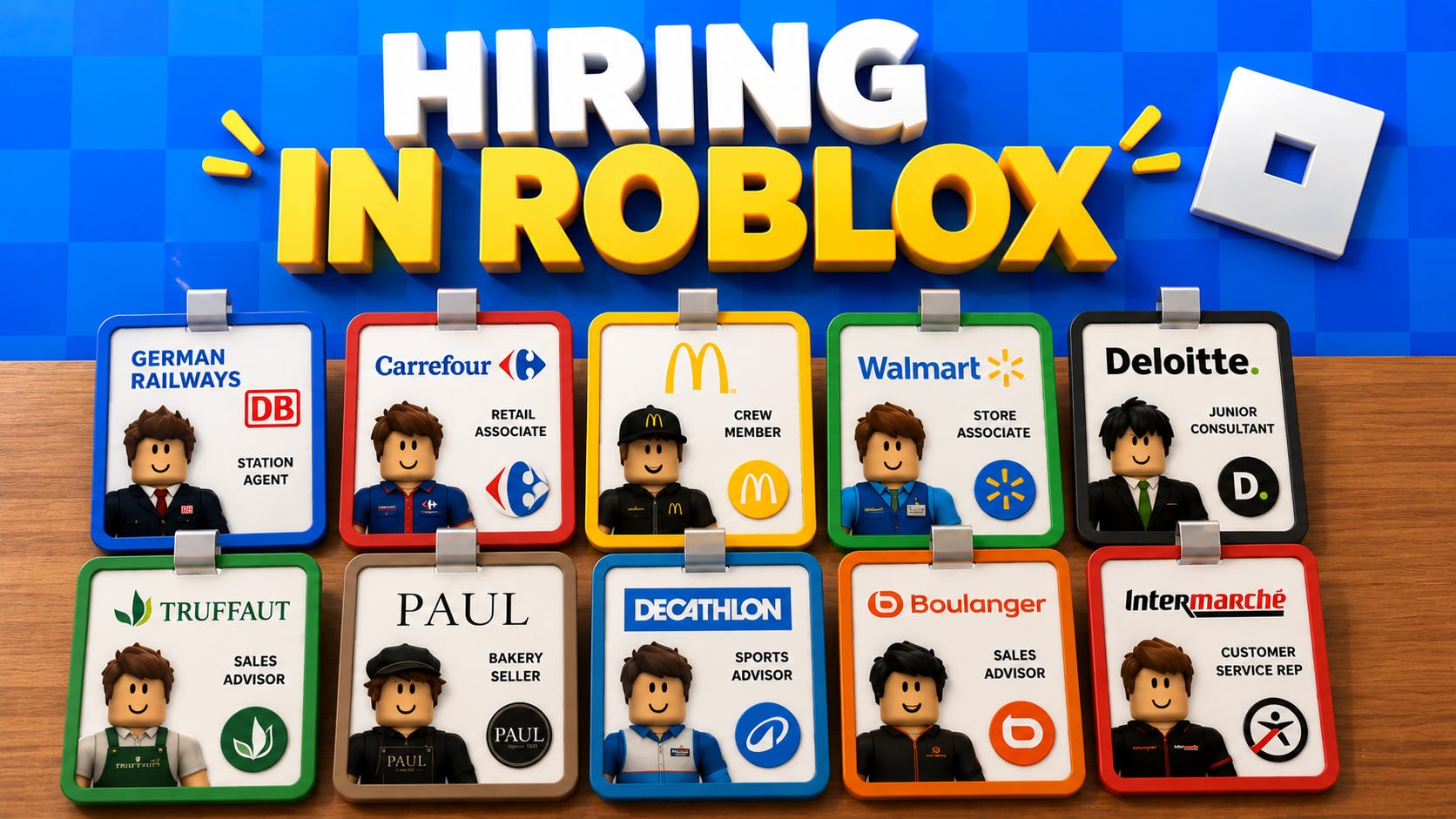
The IKEA example: recruitment inside a game
In 2024, IKEA did something that made the entire HR world look twice. On Roblox, it launched “The Co-Worker Game,” a virtual store where players could work shifts, help customers, and get promoted across departments, mirroring IKEA’s real, non-linear approach to careers.
Then it went further. IKEA actually hired a limited number of players for real, paid at its genuine hourly co-worker rate, complete with an application, a CV, and a digital interview. A furniture company ran a real recruitment campaign inside a video game, and it worked, generating a wave of press coverage across retail, HR, and mainstream media.
IKEA wasn’t the first to explore this. Even earlier, game companies experimented with bringing hiring and recruiting directly onto their own platforms. But IKEA made it legible to every brand outside gaming: this is a recruitment channel now, not an experiment.
The key insight: the game is not the point
Here’s where most people misread the IKEA story. They assume the goal is to build an elaborate, fully-functional hiring simulator. It isn’t.
You don’t need to go as far as IKEA did to win. Actually hiring people through the game is impressive, but it’s the hardest, most expensive path, and it’s not where most of the value comes from.
The real prize is the press coverage and the cultural buzz. A native Roblox experience that’s well-built and made to go viral does three things at once:
It rejuvenates your brand image, almost overnight, in front of exactly the generation that had written you off.
It anchors you in a space your competitors haven’t claimed yet, and being early in your sector is a position nobody can buy back later.
It lets a young audience that has never once considered working for you discover, playfully, what a career with you actually looks like.
That’s the difference between advertising jobs and introducing yourself to future talent before anyone else does.
Why coverage-first changes the economics
A coverage-first approach flips the logic of a career fair. Instead of paying a fixed cost to reach a shrinking room of people on one day, you build one native Roblox experience designed to travel, and you push it viral.
That last part is where distribution matters more than the build. A great experience nobody plays is a very expensive brand world sitting empty, and that’s the single most common way these projects fail. The ones that win are the ones with real distribution behind them from day one.
This is exactly what a creator-led model solves. At Empire Studio, we build native Roblox activations and push them through one of the largest French-speaking Roblox creator networks, so the experience doesn’t just exist, it trends. The coverage, the reach, and the rejuvenated brand image come from the traction, not just the game itself.
What this means for employer brand and early careers leaders
Employer brand is about to be won or lost on platforms most talent teams haven’t touched yet. The first movers in each sector will own the association between their brand and “the company that gets young people.” Everyone else will spend 2028 explaining to their board why applications from young talent keep dropping.
You don’t need to hire ten people through a game to start. You need one native Roblox experience, built well, made to travel, and backed by real distribution. The coverage does the rest.
If you lead employer brand, recruitment, or early careers, and this is quietly nagging at you, that instinct is right.
I’m Quentin Fassion, founder of Empire Studio. We help brands reach Gen Z and Gen Alpha through native Roblox activations, powered by one of the largest French-speaking Roblox creator networks. If recruitment on Roblox is on your radar, I’d genuinely like to talk it through, no pitch, just a real conversation.