
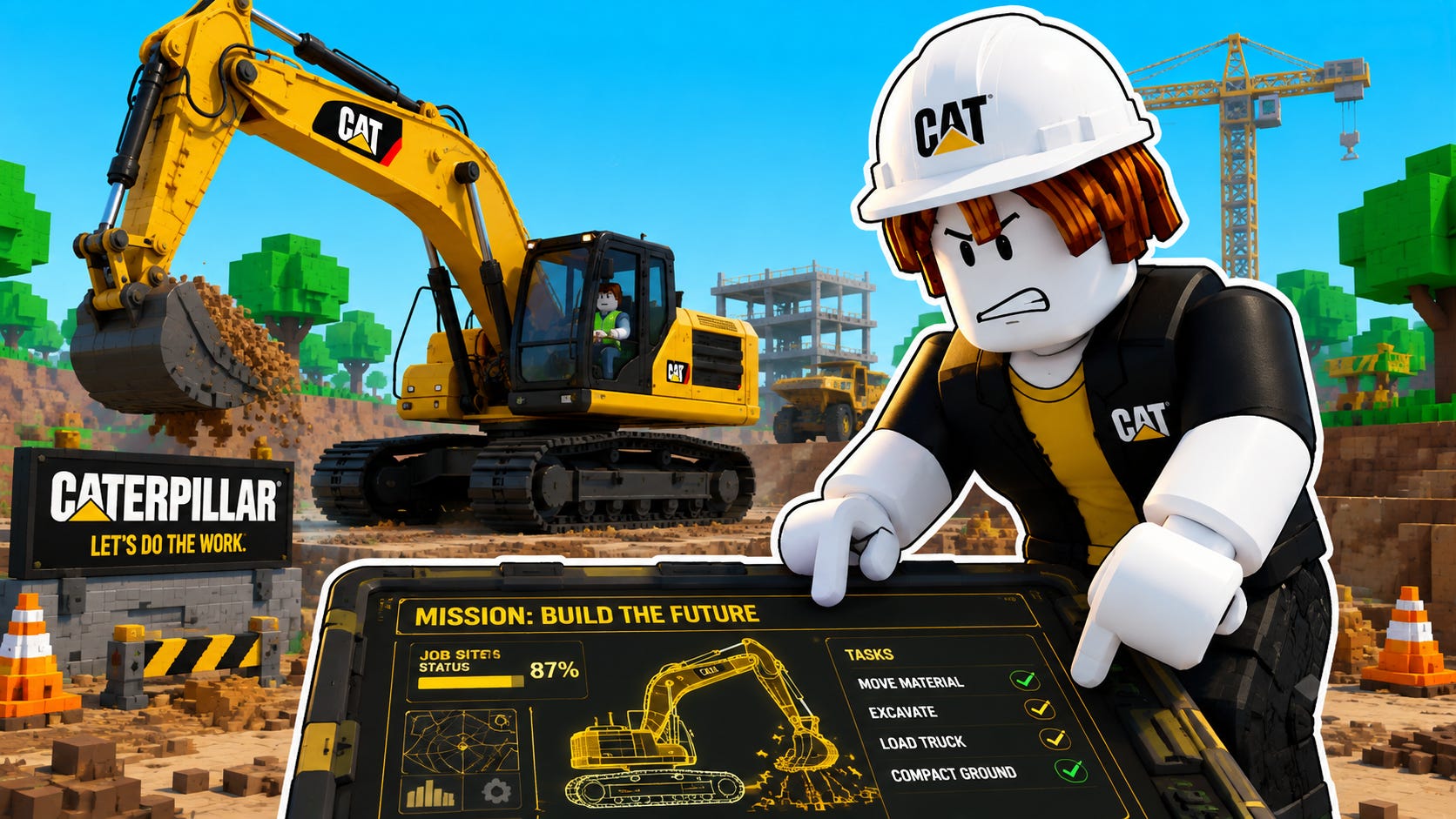
You climb into the cab of a Caterpillar excavator and the objective is simple, clear the site. Position the machine, dig, avoid the obstacles, load the haul truck, do it cleanly. When you finish, the game scores you, safety 94, precision 89, efficiency 91. And whatever you expected walking in, the first feeling you actually get is I could be good at this.
That feeling, in the first three minutes, is the entire reason this concept works. Because the hardest thing about recruiting into heavy industry isn’t convincing people the work matters. It’s the picture in their head before they ever look.
Let me walk through the whole thing, and why Caterpillar specifically is one of the strongest fits in this space.
The picture problem
Ask a seventeen year old to imagine a career at Caterpillar and most of them land on the same image, a factory, repetitive work, old machinery, a guy in 1985 with a wrench. That mental model is quietly costing the whole industry, because the reality moved on decades ago and the image didn’t.
A modern Caterpillar technician is closer to a mechanic, an electrician, a software user and a data analyst rolled into one, making decisions on machines worth millions. Caterpillar itself has spent years using immersive 3D and VR to visualize machines before they’re built, and pushing AR, AI and data across training and fleet operations. The innovation is real and already there. What’s missing is that a young person never connects any of it to a career they could have, so the job is to replace the outdated picture with the real one, and the fastest way to change a picture is to let someone stand inside it.
Start easy, then go deep
The first mission is deliberately accessible, operate the excavator, clear the site, get scored on precision, efficiency, safety, time. Anyone can feel competent quickly, which is what pulls them in.
Then the concept turns. The machine stops performing normally, and instead of replacing it you have to work out why. A simplified service interface offers the suspects, hydraulic pressure, engine temperature, an electrical fault, a sensor issue, the fuel system, operator error, and you have to read the signals and find the real cause. The game shifts from drive a big machine to understand a complex one, which is the actual shift in perception Caterpillar needs a young candidate to make.
The machine is smart
Next a digital overlay appears over the excavator, live telemetry, fuel consumption, engine load, hydraulic pressure, productivity, maintenance status. You get a target, reduce fuel consumption by twelve percent without losing productivity, and you experiment with operating strategies until it works. Without a single piece of jargon, the player lives Caterpillar’s digital transformation as a loop, data, decision, performance. Somewhere in there they think, these things are basically computers on tracks, which is exactly right.
The technician challenge
Then you step into the service workshop, a machine rolls in with a fault, and you get a diagnostic tablet. Scan it, identify the fault, locate the component, replace it, run a system test, return it to service, all as a timed technical challenge. The point isn’t to make anyone feel like a mechanic from forty years ago. It’s to show that the modern technician is a mechanic and an electrician and a software user and a problem solver at once, which happens to be exactly the role Caterpillar most needs young people to find aspirational.
From one machine to the whole site
The scope keeps widening. You become the operations planner, and a site has to move a set amount of material by a deadline. You choose which machines to deploy, how many, where they work, the truck routes, how it’s all coordinated, and every choice moves productivity, fuel, safety and cost. The player stops seeing individual machines and starts seeing a connected system, which is a much truer picture of what the company actually is.
Then the final mission pulls it all together, thirty minutes to save a project that’s behind schedule, diagnose why productivity dropped, operate the right machines, repair a critical one, cut wasted fuel, keep the whole fleet moving. The site visibly transforms as they fix it, and it closes on a line that sets up progression rather than a dead end, you’re ready for the next machine.
Find your fit
After a few missions the game hands the player a skills profile drawn from how they actually played, mechanical thinking, problem solving, systems thinking, precision, leadership, and maps it to real Caterpillar career areas. Strong mechanical thinking points toward technician, systems thinking toward engineering, data and optimization toward digital and technology, operations toward manufacturing, leadership toward site and project management. The player isn’t handed four hundred openings, they’re shown where they might fit based on what they naturally did, and that difference is the whole thing.
The skills-gap answer
Caterpillar’s real investment in workforce development gives this a credible destination, and I’d build a Cat Academy area around it, a virtual training facility showing the progression, learn, train, certify, work, grow. The message a young player walks away with is the one the manufacturing skills gap most needs, you don’t need to know how to fix this machine today, you need to be willing to learn how, and there’s a path. For apprenticeships, technician routes and STEM outreach, that lands far harder than a job ad ever could.
Great machines need great teams
Caterpillar’s “power of everyone” idea works better as a mechanic than a slogan, so some missions need more than one player. One operates the excavator, one runs diagnostics, one handles logistics, one watches safety, and the mission can’t be done efficiently alone. Players get rewarded for coordinating, and the culture message lands on its own without a corporate slide, great machines need great teams.
Built for creators, not silence
A brand game that launches quietly is a brand game nobody plays, so this is designed for creators from the start. The content writes itself, I have ten minutes to fix a Cat excavator, can I run a ten million dollar construction site, Roblox just turned me into a heavy equipment technician, with creators competing on safety, efficiency, productivity and time. That turns a recruitment message into entertainment, and it’s the part I care about most, because building the experience was never the hard part, getting the right young audience to show up on day one is.
The honest part about connecting it to real hiring
I’ll be precise here, because most concepts skip it. You cannot drop a clickable link inside a Roblox experience that sends a player to the Caterpillar careers site, the platform doesn’t allow linking out from inside a game, so the real handoff happens around the experience, through the campaign, the experience page, the creator content and the follow up. The game builds the curiosity and the intent at scale, and Caterpillar’s real recruitment journey picks it up outside the game. A partner who tells you that up front is worth more than one who promises an in game apply button that can’t exist.
What the talent team actually gets
Beyond player numbers, Caterpillar can see experience starts, completion, session time, which career categories people click, career-page visits, application starts. And in aggregate the gameplay becomes talent intelligence, a read on which career areas actually attract young technical talent, technician versus engineering versus digital. For an employer brand team, that answers a better question than “how many people saw us,” it answers “what actually made them want to work here.”
Why I’m writing this
Whene I was 15, I was trainee in a construction company. It required physicals aptitudes, pragmatism and skills to use a jackhammer, right. But it was more about cohesion. And that’s what I wanted to explore with this game, I think that it can be truly relevant to build this game.
Nobody asked me to design this, it’s a concept. But it’s the natural next step for a company that already made immersive tech part of how it works, and the ones that move first in their sector will own the association with the next generation of technical talent before anyone else can.
I’m Quentin Fassion, founder of Empire Studio. We design native Roblox activations like this one, and just as important, we push them through one of the largest French speaking creator networks we’ve built, so the experience doesn’t just exist, it actually gets seen. If you lead employer brand or early careers and you’ve wondered what this could look like for your company, this is it, and my DMs are open.
Independent concept created by Empire Studio. Not affiliated with, authorized by, or endorsed by Caterpillar. All trademarks belong to their respective owner and are shown here for illustrative, non commercial concept purposes only.