
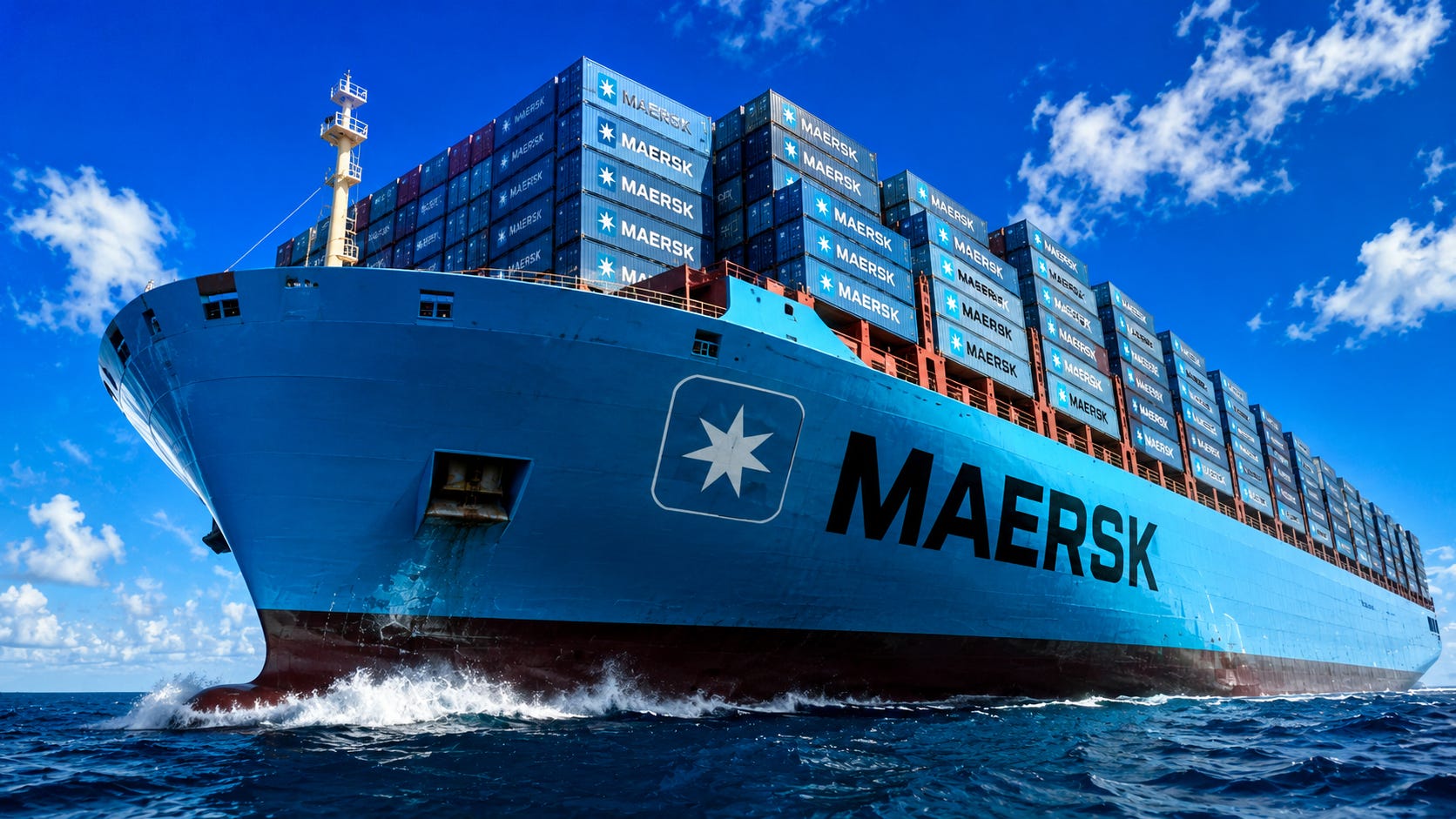
A huge operations hub materializes around you, screens everywhere, and in the middle a single line lights up.
THE WORLD IS MOVING. Your job is to keep it moving.
Then a 3D map of the planet flickers on, and the routes start drawing themselves across it, Shanghai to Rotterdam, Rotterdam to Hamburg, Hamburg to New York, thousands of tiny containers flowing along the lines like blood through veins. For a second it’s almost hypnotic, you’re just watching the whole world trade in real time.
And then the map turns red in one spot. A disruption has just occurred.
And here’s the thing, you’re not reading about logistics, you’re not being shown a video of what Maersk does, the problem is already yours and the clock is already moving, and whatever you do next actually changes the map in front of you. That shift, from watching global trade to being responsible for it in the first ten seconds, is the whole idea, and it’s exactly why this would hold a seventeen year old who would have closed a corporate careers page in about four seconds.
Let me explain what I’d actually build, and why Maersk specifically is close to a perfect fit for it.
Not a boat sim, a living network you keep alive
Most agencies handed this brief would build a ship driving game, steer the vessel, dock it, done. And it would completely miss what Maersk actually needs to say. So the concept isn’t about driving a boat, it’s about running the chain, keeping the whole global network moving, which is a far bigger and far more interesting job.
Each session is a day inside the Maersk network. A container might hold car parts, medicine, electronics, or food, and your job is to get it where it needs to go, except the network never sits still, there’s bad weather, a congested port, a delayed vessel, a system outage, a customs problem, a sudden shift in demand, a security incident, a new route to open. You react, you prioritize, you adapt, and the map responds to every call you make. It’s a tycoon at heart, but the thing you’re growing isn’t a theme park, it’s the world’s trade.
The genuinely clever part, one problem, many careers
This is where the concept stops being a nice game and becomes a real employer brand engine.
Picture the event on screen, port of Rotterdam, four vessels delayed, twelve thousand containers affected, what do you do. Now here’s the trick, the answer depends entirely on who you are. The Data player can dig into the flows and find the pattern. The Operations player can reorganize the routes. The Technology player can fix the failing system underneath. The Maritime player can rework the vessel scheduling. The Design player can simplify the wall of information so everyone else can actually act on it.
Nobody solves it alone. And that single mechanic teaches, without one word of corporate copy, the exact thing Maersk struggles to communicate, that it isn’t one job, it’s thousands of careers working together. You don’t tell a young player that, you let them feel it when they realize they physically cannot fix the crisis without the person playing the role they’d never heard of.
The roles, and why each one matters
When you join, you choose what you bring, and each path is a real family of Maersk careers, not a label. Operations, where you keep the network moving across routes, ports and schedules. Technology, because a shipping company at this scale is really a tech company, and you build and defend the systems behind global trade. Data and AI, where you find the signal in the noise and predict disruptions before they hit. Digital design, where you make brutal complexity simple enough to pilot. Engineering, where you solve the physical and technical problems that keep everything running. And Maritime, where you discover what it actually takes to move the world by sea, with the real constraints of a vessel.
Six doors, and a young technologist who assumed Maersk meant boats suddenly sees data scientists, AI engineers, UX designers and cybersecurity specialists sitting at the center of the whole thing.
Built for co-op, because that’s the honest version of the work
I’d make this four to six players, each with a specialty, and I’d open on something that sets the tone, six players, one network, zero room for error. Then the event lands, and each player receives different information, Data knows a route is quietly turning inefficient, Operations knows a port is saturated, Tech sees a system anomaly, Maritime knows the vessel constraints. They have to actually talk to each other, and the whole server watches the network shift in real time as they do.
That measures something a CV never could, how a person thinks when the picture is incomplete and the ground is moving, whether they share what they know or sit on it, whether they coordinate or freeze. For a company hiring exactly those instincts, that’s a screening signal hiding inside a genuinely fun game.
The 72 hour challenge
The mission I’d build the marketing around is this. A fictional natural disaster hits a major trade route, and the player is handed a single line, seventy two hours to restore the network. Then it unfolds, identify what’s happening, prioritize what’s critical, reroute, collaborate, deliver, and the world map slowly reorganizes in front of them as they work.
And when they pull it off, the game doesn’t say congratulations, you completed the mission, it says something that lands far harder, the network is moving again, you kept the world moving. That’s the difference between a game ending and an employer brand landing, one is a score, the other is a feeling a seventeen year old carries out of the experience.
Turning their VR credibility into recruitment
Here’s the strategic hook I’d put in front of their talent team. Maersk already has real credibility in immersive training, they’ve used VR to teach faster and improve real behavior, so this isn’t asking them to believe in something new, it’s taking a technology they already trust and giving it a new job. You can even carry over the principles from their training work, hazard recognition in a port environment, a safety decision when a situation turns dangerous, a leadership moment when an incident needs coordinating.
The line that sells it is simple, you’ve already proven immersive learning works to develop your people, now use the same mechanism to attract the people you don’t have yet. VR training becomes VR recruitment, and Maersk doesn’t start from zero.
The Maersk Career Map
As the player moves through the roles, the experience quietly builds a map of them, and at the end it hands them something they’ll actually want to keep, bars filling across Maritime, Data and AI, Technology, Operations, Digital, Engineering, then a callout, your strongest area, Data and AI, you enjoy solving complex problems using information and systems, and under it a short list of real roles to explore.
And the framing is the whole point, it isn’t here are our five hundred openings, it’s based on what you enjoyed doing, here’s where you might belong. That reversal matters enormously to Gen Z, because the experience gives them something about themselves before it ever asks anything of them, and people share the thing that describes them, not the job ad.
Day in the life, the natural next step
Once a player finds their strongest area, say Data and AI, they can step into a day in the life, a small premium space with a desk, colleagues, the real tools, a genuine problem to look at, and a short video of an actual Maersk employee talking about the job. Same for a UX designer, a software engineer, a port operations manager, a marine engineer. The game quietly becomes a career discovery platform wearing the clothes of a game, which is exactly what you want, discovery that never feels like recruitment.
The perception problem this actually fixes
Here’s Maersk’s real challenge, and why this concept fits them better than almost any brand. Say the name Maersk and a young person thinks ships, containers, ports, full stop. Meanwhile Maersk needs AI engineers, data scientists, UX designers, software engineers, digital product managers, cybersecurity specialists, operations talent. The game tells the exact inverse of the assumption, the ships are only the visible part, and behind every one of them there are millions of decisions, thousands of people, data, AI, technology, engineering, the actual machinery of global trade. You don’t argue someone out of a stereotype, you let them play the truth for twenty minutes.
The honest part about connecting it to real hiring
Most concepts wave their hands here, so I’ll be precise, because getting it wrong on Roblox is easy. You cannot drop a clickable link inside the experience that sends a player straight to the Maersk careers site, Roblox does not allow sending users out to external sites from inside a game, and anyone who promises you an in game apply now button that links out doesn’t actually understand the platform. The real bridge happens around the experience, through the campaign, the experience page, the press, the follow up, the game creates the intent and the affinity at scale and the real recruitment funnel picks it up outside the game. Telling you that up front is exactly the kind of thing you want from a partner, rather than discovering it at launch.
## The part that actually decides whether it works
Building a beautiful Maersk world is the easy part, any strong studio can model a gleaming operations hub and a world map full of ships. The hard part, the one that quietly kills most brand games, is that they launch and sit empty, because building was never the bottleneck, getting the right young audience, and here specifically the tech-minded ones Maersk can’t hire fast enough, to actually show up on day one, that’s the bottleneck. Roblox is full of gorgeous brand worlds nobody ever visited. Distribution is the whole game, it’s the piece brands almost always forget to budget for, and honestly it’s the part I care about most, because it’s the genuinely hard one.
Why I’m writing this
Nobody asked me to design this, it’s a concept, but it’s the natural next step for a company that already proved immersive learning works inside its own walls, and the ones that move first in their sector will own the association with the next generation of digital talent before anyone else can buy it back.
I’m Quentin Fassion, founder of Empire Studio. We design native Roblox activations like this one, and just as importantly we push them through one of the largest French speaking creator networks we’ve built, so the experience doesn’t just exist, it actually gets seen. If you lead employer brand or early careers and you’ve been wondering what this could look like for your company, this is what it looks like, and my DMs are open.
Independent concept created by Empire Studio. Not affiliated with, authorized by, or endorsed by A.P. Moller Maersk. All trademarks belong to their respective owner and are shown here for illustrative, non commercial concept purposes only.