
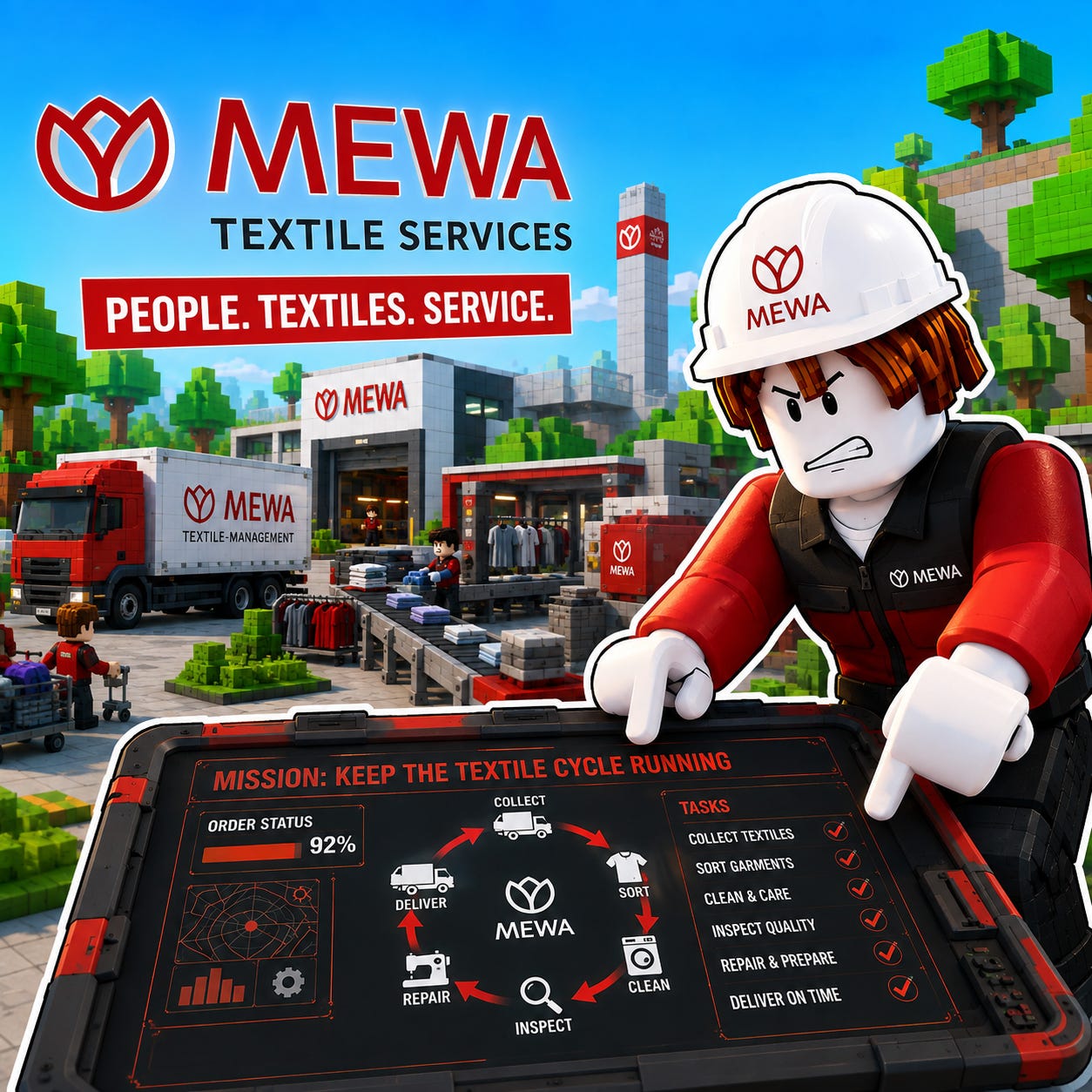
An order clock starts ticking, and a bin of used work garments lands in front of you. Your job is to get them through the whole cycle before the deadline, pick them up from the client, scan and sort them by condition and size, run the industrial wash, inspect them, repair the ones worth saving, prepare the delivery. Simple to describe, and the moment two more orders land while you’re still on the first one, not simple to do.
That pressure, in the first few minutes, is the reason this works as more than a virtual tour. Because the hardest thing about recruiting into a company like MEWA isn’t convincing people the work matters. It’s that they never picture the work at all.
Let me walk through the concept, and why a company most people would call boring is actually a strong fit for this.
The invisible-career problem
Say MEWA to a nineteen year old and, if they place it at all, they picture work uniforms and laundry. What they never picture is what actually runs the business, the automation on the sorting lines, the logistics moving garments across a region, the IT and digital systems tracking every item, the quality engineering, the sustainability work that’s genuinely central to a textile-cycle company. Those careers exist in large numbers, and they’re completely invisible to the people who’d be good at them.
That’s a pure perception gap, and it’s the kind a game closes better than any careers page, because you can’t argue someone into seeing a job differently, but you can let them do a version of it for ten minutes and watch the picture change on its own.
The cycle is the game
The core loop follows one garment through six stages, and each stage is a small piece of a real job. Collect, where you pick up used workwear from client sites. Sort, where you scan and route textiles by condition, size and destination. Clean, where you run and optimize the industrial washing machines. Inspect, where you find the garments that need repair or replacement. Repair, where you fix textiles and put them back into circulation. Deliver, where you prepare orders and organize the runs back out to client companies. The goal is to keep the whole facility flowing without a bottleneck while orders keep arriving, which is exactly the real challenge of the actual operation.
The decisions that make it real
A tour would be boring. What makes this a game is that the facility throws real problems at you and asks you to choose. An urgent order, 2,400 garments to deliver in 18 minutes. A machine issue, production efficiency down 23 percent. A quality check, 17 garments failed inspection. Each one is a small decision with consequences you can see in the flow of the plant, and each one quietly teaches the same lesson, that working here is about technology, logistics, people and solving problems under pressure, not about fabric.
What could you do here
As the player moves through the cycle, the game lets them start as an operator and gradually unlock the roles they never knew existed, industrial engineering, logistics, automation, IT and digital, quality management, operations, maintenance, sustainability, customer service. Each one is a real MEWA career family, surfaced through play rather than a list. The quiet question the game keeps asking, what could you do at MEWA, gets answered by what the player naturally reaches for.
The screen that does the work
At the end, the game reads how they actually played and hands them a profile, operations, problem solving, logistics, technology, sustainability, scored on their real choices, with a best match at the top, maybe operations and engineering, you like solving problems and keeping complex systems running. Under it, a way to explore the matching MEWA careers.
The framing is the whole point. Instead of showing a young person a wall of openings, it shows them something about themselves first, and only then points to where that fits at MEWA. People carry a description of themselves out the door. They forget a job ad by the time they’ve closed the tab.
The honest part about connecting it to real hiring
I’ll be precise here, because most concepts skip it. You cannot drop a clickable link inside a Roblox experience that sends a player straight to the MEWA careers site, the platform doesn’t allow linking out from inside a game, so the real handoff happens around the experience, through the campaign, the experience page, the creator content and the follow up. The game builds the curiosity and the intent at scale, and MEWA’s real recruitment journey picks it up outside the game. A partner who tells you that up front is worth more than one who promises an in game apply button that can’t exist.
Built for creators, not silence
A brand game that launches quietly is a brand game nobody plays, so this has to be designed for creators from the start, with content angles that actually work, can I run an entire textile facility without a single late delivery, that kind of challenge, creators competing on speed, efficiency and quality. That turns a recruitment message into entertainment, and it’s the part I care about most, honestly, because building the experience was never the hard part, getting the right young audience to show up on day one is.
The part I’d be straight about with MEWA
One honest note specific to this one. Unlike some brands, I don’t have a signal that MEWA has done immersive or gaming work before, so I wouldn’t pretend this extends an existing strategy. It’s a fresh idea for a sector that hasn’t moved here yet, and that’s actually the opportunity, being first in industrial textile care means owning the association with young technical talent before any competitor thinks of it. The companies that move first in their sector get that position cheaply. Everyone after pays more for less.
Why I’m writing this
This time, we change the industry. It’s a little bit different, and we can’t just do the same type of game than for the others of the season.
Nobody asked me to design this, it’s a concept. But it’s where employer brand is heading, and a company that most people underestimate has more to gain from it than almost anyone.
I’m Quentin Fassion, founder of Empire Studio. We design native Roblox activations like this one, and just as important, we push them through one of the largest French speaking creator networks we’ve built, so the experience doesn’t just exist, it actually gets seen. If you lead employer brand or early careers and you’ve wondered what this could look like for your company, this is it, and my DMs are open.
Independent concept created by Empire Studio. Not affiliated with, authorized by, or endorsed by MEWA. All trademarks belong to their respective owner and are shown here for illustrative, non commercial concept purposes only.