
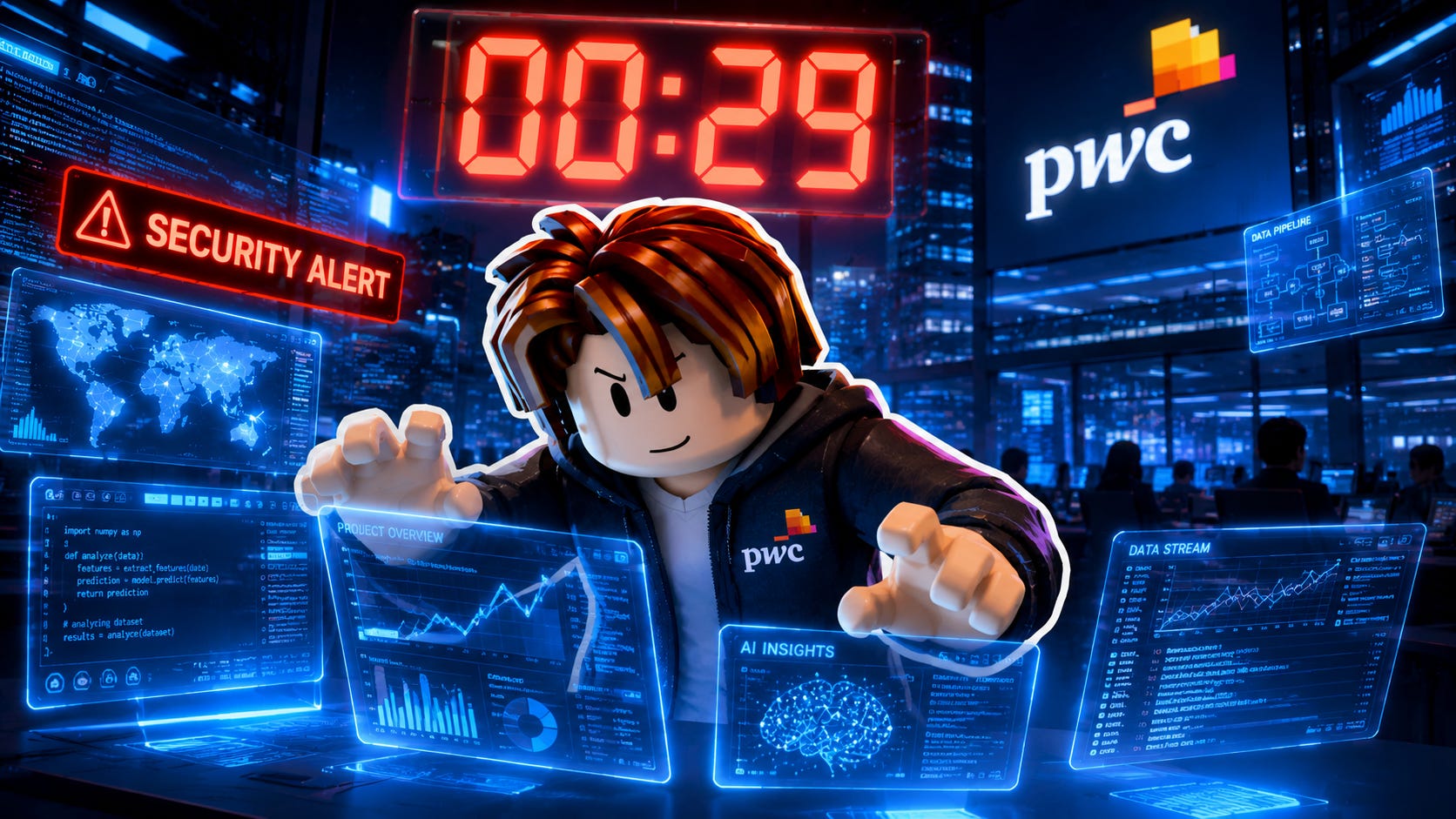
A screen lights up in front of you, black background, white text, nothing else.
YOUR CLIENT HAS A PROBLEM.
Then it keeps going, one line at a time. AI is transforming the way they work. Their workforce is struggling to adapt. Their systems are outdated, their leadership needs a plan. You have thirty minutes.
And then a single button, enter the project.
You tap it, and here’s the thing, you’re not watching a character explain what PwC does, you’re not walking through a virtual office shaking hands with NPCs (non sense), you’re already inside the problem, the clock is already running, and the first decision is already yours. That shift, from being told about the work to doing the work in the first ten seconds, is the entire idea, and it’s why this concept would keep a seventeen year old in the experience when a branded office tour would lose them in about forty seconds.
Let me back up and explain what I’d actually build, and why it fits PwC specifically better than almost any other brand I can think of.
Why PwC is different, and why that changes the whole design
Most brands that come to Roblox need convincing that immersive learning even works. PwC doesn’t. They already deployed VR to train soft skills across twelve US locations and found that VR learners trained four times faster than in a classroom, they’ve published their own research validating it, and they’ve been running gamified upskilling for years through programs like PowerUp. Immersive learning is already in their DNA.
So you don’t pitch them “Roblox is cool, let’s make a game.” You pitch them the obvious next step they haven’t taken yet. You already use immersive tech to develop your people. Use the same mechanism to attract the people you need next. That one sentence is the whole strategy, and it reframes the game from a marketing gimmick into an extension of something they already believe in.
And it points at their real pain, which isn’t awareness, it’s a shortage of AI and technology talent, hundreds of specialist roles that are genuinely hard to fill, at the exact moment PwC wants to be seen as the firm leading transformation. So the game shouldn’t try to make PwC look fun, it should let the rare candidates PwC actually needs feel what solving PwC’s problems is like.
You don’t play PwC, you do the work
Instead of a menu of careers to browse, you pick what you bring to the team, and the choice genuinely changes what you do.
Choose AI and Data, and your client is drowning in data they don’t know how to use, so you identify what actually matters, decide what can be automated, work out where AI creates real value versus where it just adds risk, and then present a recommendation, and right when you think you’re done, the client asks you a question you didn’t prepare for, and you have to improvise. Choose Technology, and you’re arbitrating the trade-offs that define real infrastructure work, speed against security, cost against performance, innovation against reliability, and the consequences of your call show up in the world around you. Choose Cyber, and an alert fires, unusual activity detected, and you have to understand what’s happening and prioritize under pressure.
And then there’s the one that ties straight back to PwC’s own research, People and Change. Your AI system is technically excellent, and the employees simply refuse to use it, and the game makes you sit with the lesson PwC talks about constantly, technology doesn’t transform a business, people do, so you build an adoption plan instead of a technical fix. That single mission does more employer brand work than any brochure, because it shows a young technologist that PwC understands the human side of transformation, not just the code.
The twist that makes it a team sport 🏀
Here’s where it stops being a solo puzzle and becomes something you can’t fake your way through.
You put four players on the same team, and each one holds different information, one has the AI and data picture, one has cybersecurity, one has people and change, one has business strategy. None of them can solve it alone, they have to actually communicate. And then, just as they’ve aligned on a plan, the system drops an event, the client has just changed its strategy, and everything they prepared has to be reassessed on the spot.
That moment measures something a CV never will, how a person thinks when the ground shifts, whether they hoard information or share it, whether they lead or freeze. For a firm that hires for exactly those qualities, that’s not a game mechanic, that’s a screening signal disguised as fun.
The PwC Skills Profile
After a few challenges, the experience hands the player something they’ll actually want to screenshot, a personal skills profile. Problem solving, adaptability, collaboration, digital thinking, communication, critical thinking, each with a score, and then a standout skill called out with a sentence that feels personal, something like, you tend to question assumptions and identify risks before deciding. Under it, a short list, careers to explore, mapped to how they actually played.
This is the quiet genius of the whole thing, because it flips the emotional direction of recruitment. Normally the candidate is the one being judged, here the experience gives them something about themselves, and it just happens to end on discover your career at PwC. People don’t share job ads, they share things that describe them.
Why this beats a job ad, and beats their own PowerUp
PowerUp answered an internal question, how do we upskill the workforce we already have. This answers the one keeping their talent team up at night, how do we attract the next generation of digital talent. Same philosophy, pointed outward instead of inward, which is exactly why it’s an easy yes for a firm that already believes in the method.
And it fixes a perception problem PwC genuinely has with young people. A seventeen to twenty-two year old still thinks PwC means audit and accounting, and they finish this experience thinking, wait, they have AI engineers, cybersecurity specialists, technology consultants, that’s the real employer brand win, not a logo on a billboard, an actual shift in what the brand means to someone who’d never have considered it.
The Future Lab, where the game hands off to real hiring
When the mission ends, the player arrives in a small, premium space, not a giant theme park, a clean hub called the PwC Future Lab, with a few doors, AI and Data, Cyber, Technology, People, and each one holds a short experience and a video of a real PwC person talking about what they actually do.
This is the bridge, and it’s where I have to be precise with you, because most concepts get this wrong. You cannot put a clickable link inside a Roblox experience that sends a player straight to the PwC careers site, Roblox does not allow sending users out to external sites from inside a game, and anyone promising you an in game apply now button that links out doesn’t understand the platform. The real handoff happens around the experience, the campaign, the experience page, the press, the follow up, and the Future Lab is what creates the intent that the real recruitment funnel then picks up outside the game. Telling you that honestly up front is exactly the kind of thing you want from a partner, rather than finding it out at launch.
The measurement that turns this into an employer brand tool, not just a campaign
You can obviously measure the usual, players, sessions, completion rate, average playtime, challenges finished, career paths explored, skills discovered, careers clicked. But the number that matters most to a Head of Employer Brand is career intent, and you can actually capture it, because you ask once before the experience, how interested are you in working at PwC, and once after. The shift between those two answers is the whole story. Being able to walk into a room and show plus whatever percent in consideration among players turns this from a nice activation into a measurable employer brand instrument, which is the language that gets budget approved.
The part that actually decides whether it works
Building a sharp, premium PwC experience is the easy part, any strong studio can do it. The hard part, the one that quietly kills most brand games, is that they launch and sit empty, because building was never the bottleneck, getting the right young audience, and here specifically the tech-minded ones PwC wants, to actually show up on day one, that’s the bottleneck. Roblox is full of beautiful brand worlds nobody visited. Distribution is the whole game, it’s the piece brands almost always forget to budget for, and honestly it’s the part I care about most, because it’s the genuinely hard one.
Why I’m writing this
Nobody asked me to design this, it’s a concept, but it’s the natural next step for a firm that already proved immersive learning works inside its own walls, and the companies that move first in their sector will own the association with the next generation of digital talent before anyone else can buy it back.
I’m Quentin Fassion, founder of Empire Studio. We design native Roblox activations like this one, and just as importantly we push them through one of the largest French speaking creator networks we’ve built, so the experience doesn’t just exist, it actually gets seen. If you lead employer brand or early careers and you’ve been wondering what this could look like for your firm, this is what it looks like, and my DMs are open.
Independent concept created by Empire Studio. Not affiliated with, authorized by, or endorsed by PwC. All trademarks belong to their respective owner and are shown here for illustrative, non commercial concept purposes only.
Linkdin here, instagram here, email : quentin@empire-studio.com