
A timer appears at the top of the screen. Storm incoming, 24:00:00, counting down. Out through the window there’s an offshore wind farm, forty eight turbines standing in open ocean, and the weather is turning. Your job for the next twenty four game-hours is simple to say and hard to do, keep the turbines safe and keep the energy flowing.
Except you can’t see the whole picture. You’re one of six people on this team, and each of you knows something the others don’t. The data scientist can see the weather closing in. The engineer knows which turbines are mechanically fragile. The technician knows which ones are already flagged for repair. The operations manager knows who’s actually available to send out. Nobody can solve the storm alone, so you talk, you argue, you decide, and the farm rides it out or it doesn’t.
That’s the pitch, and it’s deliberately not the obvious one.
The trap most agencies would fall into
Hand this brief to a typical shop and you get build a turbine, a pretty sim where you plant a windmill and watch it spin. It shows the product and sells nothing about Vestas as a place to work. Worse, it leans on the one message a young tech talent is completely numb to.
Because here’s the thing about “save the planet.” To a seventeen year old who’s good at code or systems, it’s the expected line, the thing every green company says, and it lands like a slogan rather than a challenge. Ask that same kid whether they can keep a 2.4 gigawatt offshore wind farm running through a storm, and now you’ve got their attention, because that reads as a game. The game is what pulls them in, and once they’re in, Vestas gets to show the engineering, the AI, the data and the careers that make it real.
You start on land, and it grows
The experience opens on a coastal region that’s mostly empty, a city, some factories, roads, a bit of offshore water, a few turbines. A bar at the top reads energy demand, 72 percent, the city is growing, we need more power. Your first job is small, build the next wind farm.
But placing turbines isn’t just plopping them down. You’re weighing wind speed against terrain, distance to the grid against construction cost, environmental impact against energy demand. Without ever opening a menu that says “engineering careers,” you’re already doing the actual reasoning an engineer does. That’s the whole design philosophy here, you learn the job by doing a small version of it, never by reading about it.
Then it surprises you
Once the farm is up, you tune it, blade configuration, electrical systems, grid connection, and you get small sharp puzzles like turbine seven is at 78 percent output in 31 kilometer winds, do you adjust the blade angle, increase rotation, or reduce load. Quick, satisfying, quietly teaching.
And then the concept does the thing I care about most, it breaks the stereotype. A huge monitoring interface appears, Vestas Digital Control, twelve thousand turbines online, energy output, performance, wind forecast, AI prediction. Your task is to spot the turbine that’s about to fail before it fails. Predictive maintenance. And somewhere out there a kid who’s into tech thinks, wait, I didn’t know Vestas did this. That sentence, in that kid’s head, is the entire point of the project.
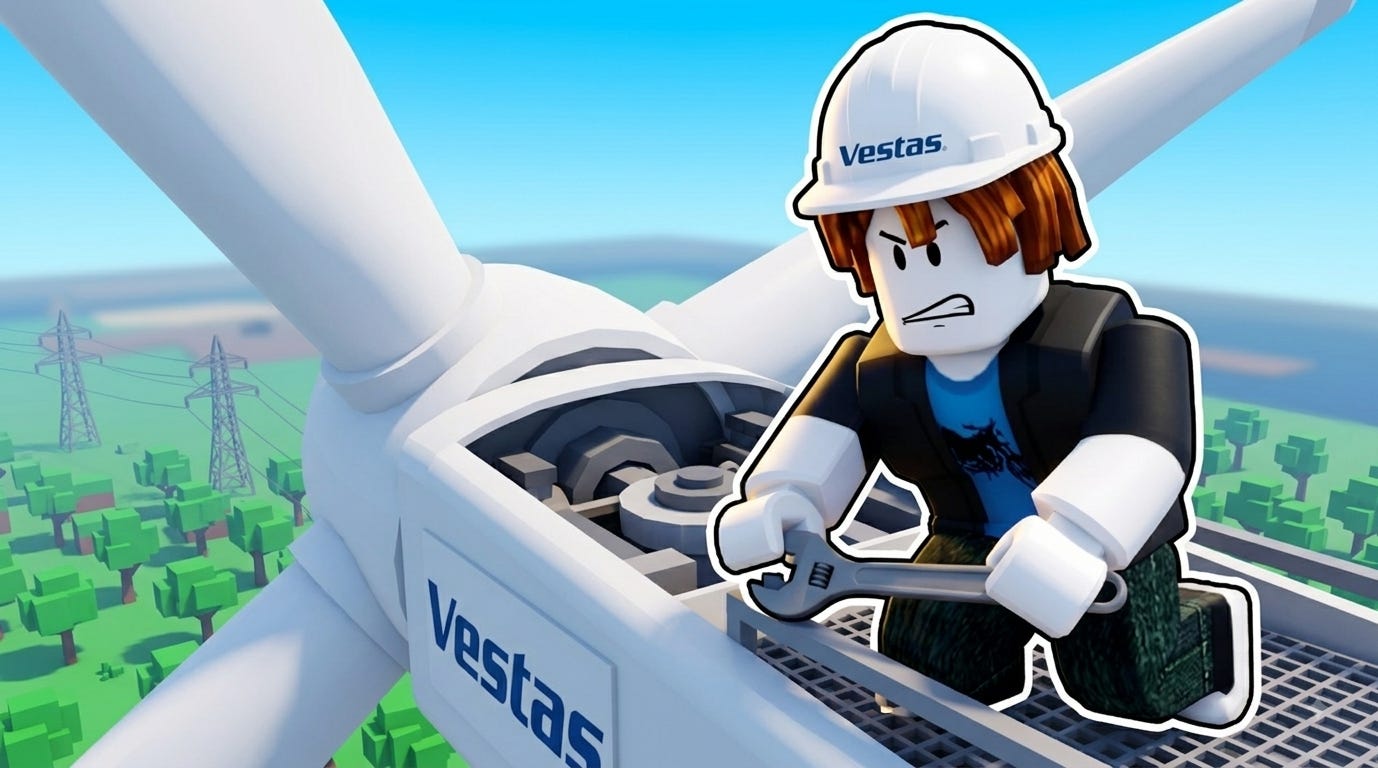
Then you can literally leave the control room and go to the field, stand at the base of a giant turbine, inspect it, find the fault, secure the area, make the repair, bring it back online. The same player goes from a monitoring dashboard to a wrench at the base of a turbine, which is exactly the range of work Vestas needs people to picture.
One energy team
The real employer brand engine is the co-op. Everyone picks a role, and they’re all genuine Vestas career families, not labels. The engineer designs the solution. The wind technician keeps turbines running. Data and AI predicts what’s coming. Electrical connects the energy to the grid. Offshore operations keeps the whole thing moving. Environment builds without wrecking the ecosystem. Project management keeps it all on track.
Each role sees different information, which means the only way through a real crisis is to actually work together. That’s not a mechanic bolted on for fun, it’s the most honest possible picture of how the work really happens, and it quietly tells a young player that Vestas is a whole system of people who need each other, not a single job title.
What the game gives back
When the storm passes, the game doesn’t flash you won. It looks at how you played and hands you a profile, you naturally gravitate toward engineering, problem solving, sustainability, digital, with the bars filled in based on your actual choices. Then a line, you could be a Vestas engineer, and under it, based on the way you played, explore the careers that match your strengths.
The framing matters more than it looks. Instead of pointing at open roles and asking the player to apply, it points at the kind of problem they’re clearly wired to solve, and shows where that fits at Vestas. The experience gives the player something about themselves first, and people carry that out the door in a way they never carry a job ad.
The bridge to real hiring, done honestly
I’ll be precise here, because it’s the part most concepts fudge and it’s easy to get wrong on Roblox. You cannot drop a clickable link inside the experience that sends a player straight to the Vestas careers site, the platform doesn’t allow sending users out to external sites from inside a game, and anyone promising you an in game apply now button that links out doesn’t really know the platform. The bridge to real hiring happens around the experience, the campaign, the experience page, the press, the follow up. The game builds the intent at scale, the real funnel picks it up outside the game. That’s the kind of thing a serious partner tells you before launch instead of after.
Where these projects live or die
Building a gorgeous Vestas world is the easy part, any strong studio can model turbines in a moody ocean. The hard part, the one that quietly kills most brand games, is that they launch and then nobody comes, because building was never the bottleneck, getting the right young audience, and here the tech-minded ones Vestas actually wants, to show up on day one, is. Roblox is full of beautiful brand worlds that sat empty. Distribution is the whole game, it’s the piece brands forget to budget for, and it’s honestly the part I care about most, because it’s the genuinely hard one.
Why I’m writing this
I see the potential for an indusry like the sustain energy to be on Roblox. Vestas needs to reach the young generation, and there future generation of technicians. It can be done with Roblox. We have the power to enhance the recruitment and the employer brand of Vestas, because we actually know where is this new generation. Spoiler : On Roblox.
Nobody asked me to design this, it’s a concept. But it’s where employer brand is heading, and the companies that move first in their sector will own the association with the next generation of technical talent before anyone else can buy it back.
I’m Quentin Fassion, founder of Empire Studio. We design native Roblox activations like this one, and just as important, we push them through one of the largest French speaking creator networks we’ve built, so the experience doesn’t just exist, it actually gets seen. If you lead employer brand or early careers and you’ve wondered what this could look like for your company, this is it, and my DMs are open.
Independent concept created by Empire Studio. Not affiliated with, authorized by, or endorsed by Vestas. All trademarks belong to their respective owner and are shown here for illustrative, non commercial concept purposes only.