
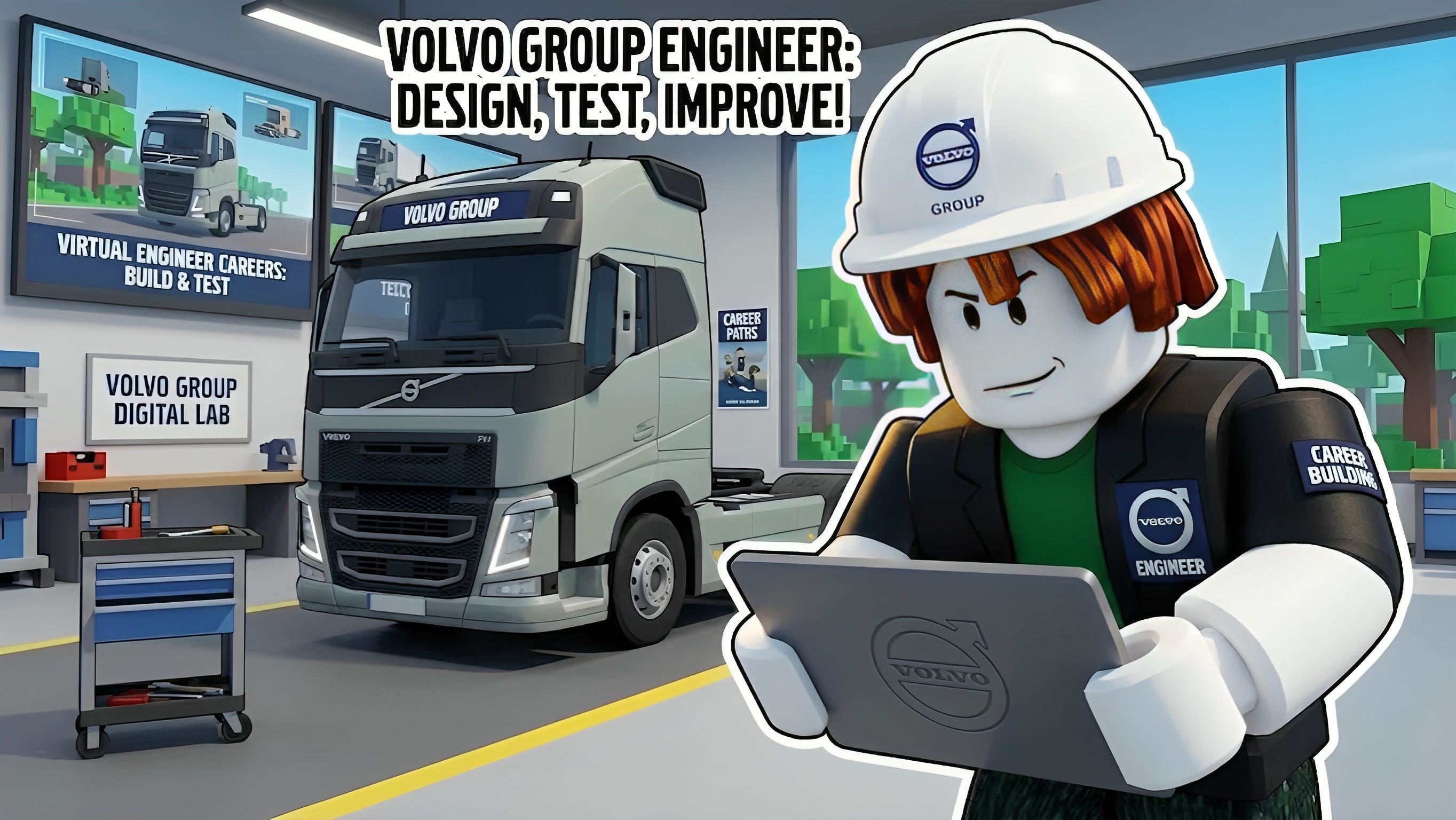
You step into a Volvo truck cabin, except you’re not here to drive it, you’re here to design it. The dashboard, the screen positions, the seat, the sightlines, the controls, all of it is yours to lay out. Then you climb into the driver’s seat and test your own decisions, and a simple readout tells you how you did, visibility, comfort, safety, usability. The point isn’t to make the cabin look nice, it’s to make the right call for the person who actually has to sit in it for ten hours a day.
That’s the first three minutes, and it already tells a young player something most industrial employers can never quite get across, that engineering at Volvo is about people, not just parts.
Let me walk through the whole concept, and why Volvo Group specifically is the strongest fit I’ve come across for this kind of thing.
Volvo already did the hard part
Most brands that come to an idea like this have to manufacture a connection to gaming out of nothing. Volvo doesn’t. They ran an activation at DreamHack built on the premise that gaming skills can translate into engineering ability, and they already use XR to test virtual truck cabins with real drivers before those cabins ever get built. The link between gaming, engineering and the future of transport is something Volvo has already put real money behind.
So the job here is not to convince anyone that Volvo is innovative. It’s to take a belief the company already holds and let a candidate feel it instead of reading it on a careers page. A nineteen year old who’s genuinely good at games has no idea Volvo Group is a place where that ability maps onto a real career, and still thinks of the company as trucks and nothing else. The game closes that specific gap.
You design it, then you test it
After the cabin design, you become the test engineer. A virtual driver climbs in, and you start getting real scenarios, the driver needs to find a control without taking their eyes off the road, the driver has been going six hours and needs better comfort, visibility is limited so find the safest configuration. You adjust the cabin in real time and get immediate feedback, and a small interface quietly introduces the actual Volvo XR story, test, measure, improve. Without a single lecture, the player absorbs the real lesson of engineering, that you don’t build something once, you keep making it better.
The digital twin
Then the experience opens up into a futuristic development lab where a complete truck appears as a digital twin. You walk around it, inspect it, and step into different systems, cabin, safety, powertrain, software, aerodynamics, each with its own small challenge. In software, a warning tells you the driver is getting too much information, and you have to reorganize the interface. In aerodynamics, you change the truck’s shape and watch the efficiency shift in real time. In safety, you spot the hazards around the vehicle. Hard engineering ideas turn into things you do with your hands, which is exactly how a game should teach.
The mechanic that does the real work
This is the heart of it for employer brand. At the end of each challenge, the player gets a skills profile, systems thinking, problem solving, spatial reasoning, decision making, human-centred design, scored on how they actually played. The game never claims that Roblox proves someone is an engineer, that would be silly and a smart nineteen year old would see through it instantly. What it does is plant a single thought, the things I’m naturally good at in this game are actually connected to engineering. That thought is the entire bridge between Volvo’s DreamHack strategy and real recruitment.
Where could you fit
From there the player unlocks a simple screen that maps what they enjoyed to real Volvo career areas, not a generic job board. If they liked designing, it points them toward UX and human-centred design. If they liked solving systems, software engineering. If they liked testing, engineering and validation. If they liked vehicle performance, vehicle engineering. If they liked the data, data and digital technology. And then, only then, it offers to show them where that skill actually lives at Volvo Group.
The Axel moment
The strongest single beat I’d build is turning Volvo’s real XR work into a character. The player meets a fictionalized Volvo XR engineer who explains that he works on virtual truck cabins before they ever reach the road, and then the player performs a simplified version of exactly that process. The difference in impact is enormous. Telling a candidate “Volvo Group uses XR” is a fact they’ll forget. Letting them think “I just used the same kind of technology a Volvo engineer uses” is something they’ll carry around, and repeat.
Build what’s next
The experience ends with one final mission. A new Volvo truck concept needs improving, and the player has a hundred and eighty seconds to make calls across driver experience, safety, efficiency, digital interface and sustainability. The game scores the result, and closes on a line, you built what’s next, and underneath, could you build it for real. That framing matters. It doesn’t beg anyone to apply, it hands them a small sense of achievement and lets the invitation follow from it.
Built for creators, not silence
A brand game that launches quietly is a brand game nobody plays. This one is designed for distribution from the start, around a creator challenge, can you build the most efficient Volvo truck, with a leaderboard of top engineers and creators competing against each other. That gives Volvo a genuine reason to work with gaming creators, and it turns the whole campaign into gaming, then challenge, then engineering, then Volvo, then careers, instead of an ad pointing at a job page. This is also where I care most, honestly, because the build is never the hard part, getting the right young audience to actually show up is, and a creator-led launch is what makes or breaks that.
The honest part about connecting it to real hiring
I’ll be precise here, because most concepts skate over it. You cannot drop a clickable link inside a Roblox experience that sends a player straight to the Volvo careers site, the platform doesn’t allow linking out from inside a game, so the real handoff happens around the experience, through the campaign, the experience page, the creator content and the follow up. The game builds the curiosity and the intent at scale, and Volvo’s existing recruitment journey picks it up outside the game. A partner who tells you that up front is easier to trust than one who promises an in game apply button that can’t exist.
What the talent team actually gets
The value here isn’t only player numbers. Volvo can see experience starts, completion, time spent, which career areas people interact with, career-page clicks. And in aggregate, the gameplay itself becomes talent intelligence, a readout of which career areas pull the most interest from young technical talent, software versus human-centred design versus vehicle engineering. For an employer brand team, that’s a much sharper picture of what actually attracts the next generation than any survey would give them.
Why I’m writing this
It’s not the first time that I see Volvo being implemented in Roblox. I saw integrations in games, like Driving Empire or Greenville. Volvo know how to reach gen z, but they haven’t already used Roblox for the recruitment part, and make a big press coverage impact.
Nobody asked me to design this, it’s a concept. But it’s the natural next step for a company that already brought engineering to a gaming crowd at DreamHack, and the companies that move first in their sector will own the association with the next generation of technical talent before anyone else can.
I’m Quentin Fassion, founder of Empire Studio. We design native Roblox activations like this one, and just as important, we push them through one of the largest French speaking creator networks we’ve built, so the experience doesn’t just exist, it actually gets seen. If you lead employer brand or early careers and you’ve wondered what this could look like for your company, this is it, and my DMs are open.
Independent concept created by Empire Studio. Not affiliated with, authorized by, or endorsed by Volvo Group. All trademarks belong to their respective owner and are shown here for illustrative, non commercial concept purposes only.